
ASH ARDER
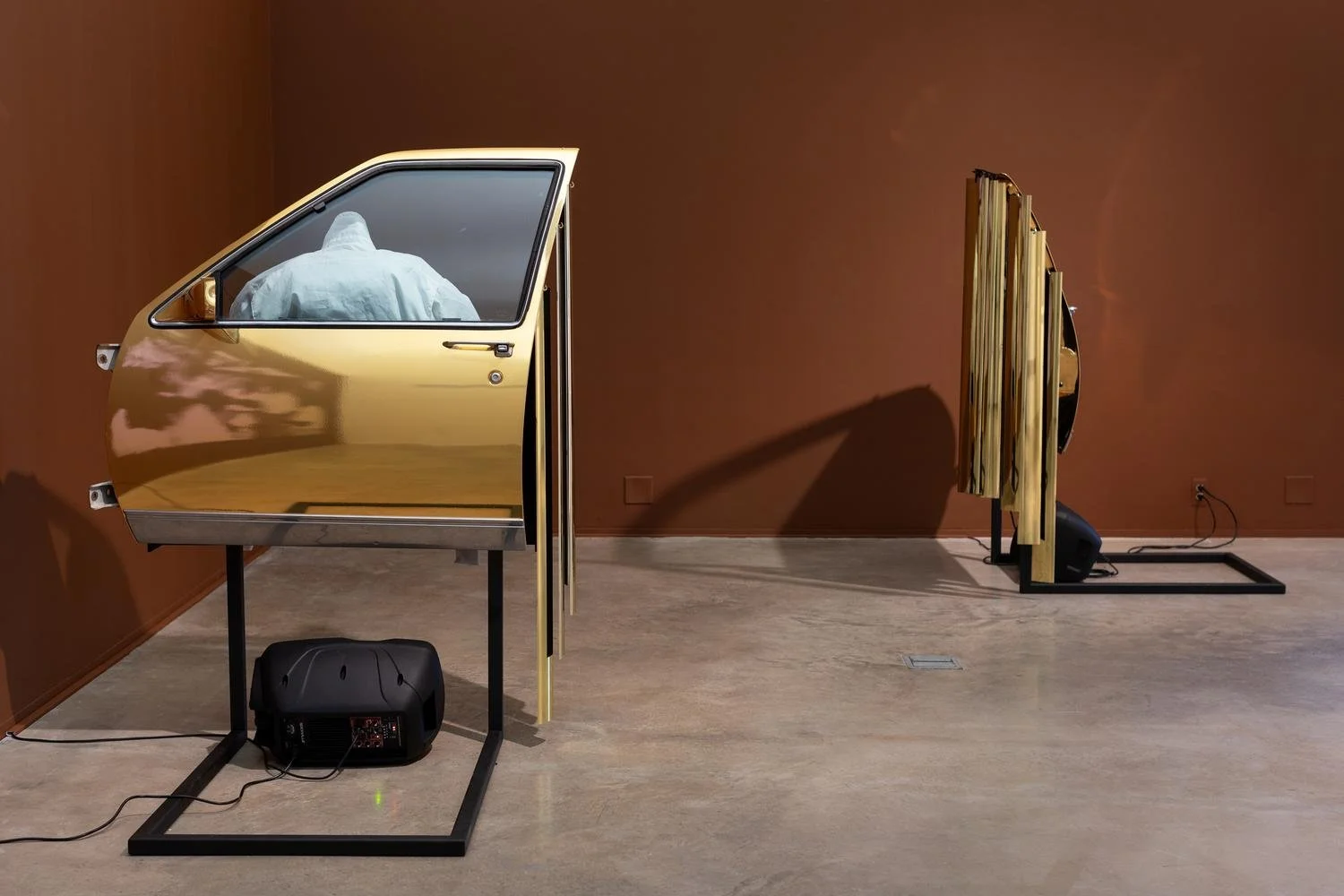
For artist Ash Arder, cars are companions. Automotive allusions are a central aspect of her sculptural and conceptual work.
“I've gone to a junkyard and liberated Cadillac doors and a Cadillac hood from the same model car we had growing up — basically turning refuse into new work.” Those works will be on display at the Medina Triennial in Western New York this summer.
Arder is a Detroit-based artist who studied at the Cranbrook Academy of Art. She was born and raised in Flint, Michigan, a historic manufacturing hub for General Motors, hence the many Cadillac references in her body of work.
Arder is one 56 artists featured at the Whitney Biennial at the Whitney Museum of Art through August. There she is showing “Consumables,” a piece made up of three Cadillac hood ornaments cast in butter, shea butter, and chocolate. The ornaments are housed in a small refrigerator powered by solar energy. To make the refrigerator work, panels were installed on the Whitney’s rooftop terrace.
“The car has been this steady collaborator— this entity that has existed in my life since I was a child — and that's because both of my parents worked in the automotive industry,” she said. Her parents met at GM and multiple family members continue to work for what was once the world’s largest multinational corporation. Arder investigates broad social issues tied to manufacturing in juxtaposition to her lived experience in cars.
“Growing up in Flint, much like Detroit, it's a very car-oriented city — and not just because it's a factory town where people work in the automotive industry, but because of the way the landscape and built environment was created. It prioritizes getting from place to place by car, not necessarily by bus, by bike, or by foot, so I spent a lot of time in the car as a kid. The car was a safe space for me. It taught me how to entertain myself.”
Arder examines the tension of the auto industry, particularly for communities built around automotive companies. “We only ever had GM cars in my family, and that carries social implications— modeling a certain status, a certain ability to afford that kind of vehicle.” Arder draws a connection between manufacturing and the possibility afforded by a different future for the industry than its current trajectory.
“I'm trying to draw a connection between a sector that regularly depletes Earth's resources and the clean energy space, which I operate in through my other work.” She poses the question, “What can solar spark for people who are working in automotive day-to-day? How can they take that shift back to work, model it, ask questions that might contribute to gradual industry change?”
The tension in her work is not adversarial, but contemplative. “I'm not flipping the bird to the automotive sector. That's not useful or generative. Rather than saying 'I'm leaving you behind,' I'm more like: I acknowledge and make space for the role you played in my own life — not just in my survival, but in my thriving.”
By mining for car parts, Arder seeks to give each part new life. “Liberating these car parts feels restorative for me — maybe I'm honoring the past but also speculating about a new future. As much as I can question the industry behind it, I can also appreciate the creativity and the design elements of this large-scale sculptural object, ultimately.”