
Shepard Fairey on his 1937 Packard Art car and why “Filthy Lucre Ain’t Nothing New”
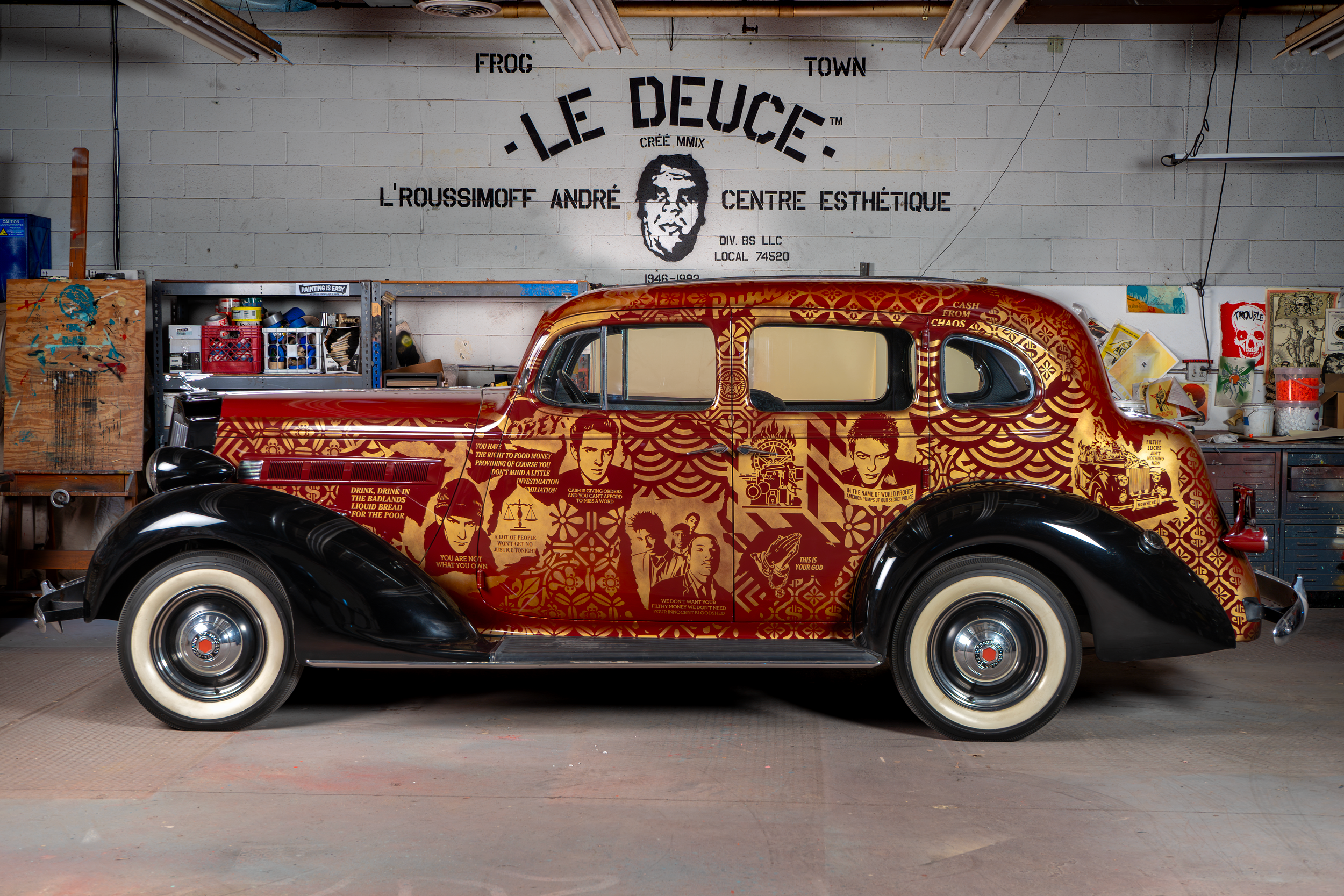
photo courtesy of Shepard Fairey
When Shepard Fairey customized a maroon 1937 Packard 115C Touring Sedan, he thought long and hard about the social commentary elicited by this stunning vehicle introduced in the throes of the Great Depression, and how that messaging translates to modern times.
Packard,a bygone Detroit manufacturer, made opulent cars in the first half of the twentieth century.Compared to prior Packard models, the 115C was modest, but still an extravagant car for the time, aimed at Americans who could afford upper-middle class luxury. This model had a less powerful engine, but upscale features like hand-finished bodywork and hydraulic drum brakes.The car sold so well — almost 30,000 examples — that it saved the company from financial ruin long before its 1958 collapse.In its heyday, Packard projected executive swagger and propped up its brand image with the tagline “Ask the Man Who Owns One.” In this work, Fairey questions “the man” — and what this social context represents — in glittering golden imagery.
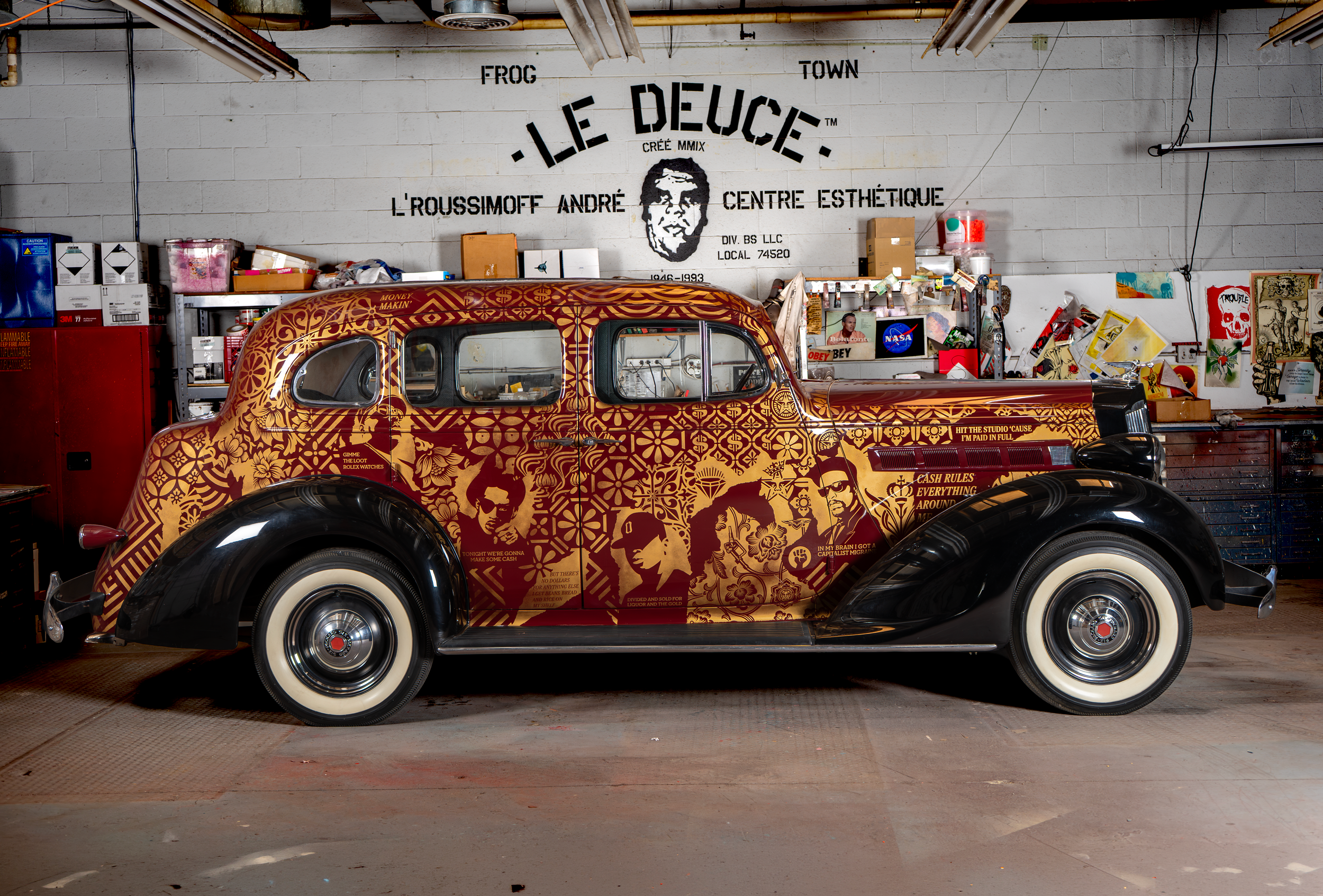
photo courtesy of Shepard Fairey.
Larry Warsh, a longtime collector of Fairey’s work, commissioned the car as part of his expansive art car collection built around the concept of the automobile as a social artifact.Warsh’s sprawling collection includes cars customized by Keith Haring, Barbara Kruger, and Ai Weiwei. The Fairey car will debut at Fairey’s solo exhibition “Filthy Lucre Ain’t Nothing New” organized by Warsh’s Cart Department on view Sept. 24 to Sept. 27 at 16 Morton Street in New York City.
When Warsh showed Fairey the Packard acquired from a private collection in Beverly Hills, Fairey immediately connected the body type to his 2016 collaboration with Jamie Reid, the graphic artist for the Sex Pistols. For that work, two dueling images of Rolls-Royce Phantoms symbolized excessive fossil fuel consumption and hyper capitalism.On the driver’s door of the Packard, Fairey’s imagery references the punk rock movement, and on the passenger side, he explores the financial braggadocio found in some aspects of hip-hop culture. Both genres emerged in the late twentieth century as the soundtracks to youth counter-culture movements and is foundational to current time.
“I look at both sides of the car as different takes on the struggles people feel in how they navigate capitalism.”
Lyrics by Slick Rick, Chuck D, the Notorious B.I.G.,Joe Strummer of the Clash, and Jello Biafra of the Dead Kennedys are used for text imprinted on the exterior. “We don't want your filthy money/ We don't need your innocent bloodshed” is a lyric from F.V.K by Bad Brains painted on the driver’s side in contrast to the Eric B. & Rakim lyric positioned near the passenger door,“Hit the studio, ‘cause I’m paid in full.” Fairey references Reid’s signature album cover work with the Sex Pistols, particularly in punk rock iconography.The show’s title borrows from the Sex Pistols lyric, also inscribed on the car. Fairey, a working DJ, edited a mix as a conceptual part of the car, juxtaposing punk and hip hop’s stylistic energy. Tracks by KRS-One, Slick Rick, Public Enemy, Dead Kennedys, Bad Brains, Fugazi, and the Sex Pistols weave into this conflicting narrative.

photo courtesy of Shepard Fairey.
“I look at both sides of the car as different takes on the struggles people feel in how they navigate capitalism,” Fairey said in an interview. “I feel those struggles all the time including wanting to make my work very democratic and accessible but also making expensive art objects including this very luxurious car,” he said. The car is purposely ornate, down to its shimmering floral pattern.
Fairey considers himself outside of car culture, but after decades living in LA, he is surrounded by car enthusiasm as an influence. “I get to see a lot of painted lowriders and things done by people like Mister Cartoon, like his ice cream truck that was in Art in the Streets show.” When Fairey lived in San Diego, he paid attention to the car collectors stunting at meetups near his home.
For the Packard, he studied customization techniques and collaborated with automotive specialists. It was important to him to make the car appeal to car aficionados. “I wanted it to be cleaner because this is a culture that bristles at messiness,” he said. “I wanted it to feel very controlled and precise in other ways.Everything was masked off very carefully and the spray paint was applied in slow, deliberate coats in a way that is not haphazard. I wanted people to see the connection to my history as a street artist using stencils as a medium, but I did not want it to be at all sloppy.” Fairey’s long history with site-specific murals at scale informed his work on the car’s exterior. “One of the things that murals have helped me to problem solved is how things need to work from a distance,” he said.
Prints and lithographs will also be on display, using the car as the centerpiece of the exhibition. “There’s a really beautiful gloss finish on the car and some interesting tension between the presentation and the content,” he said.