
Le Car Design Talks: Rolls-Royce Design Chief Domagoj Dukec
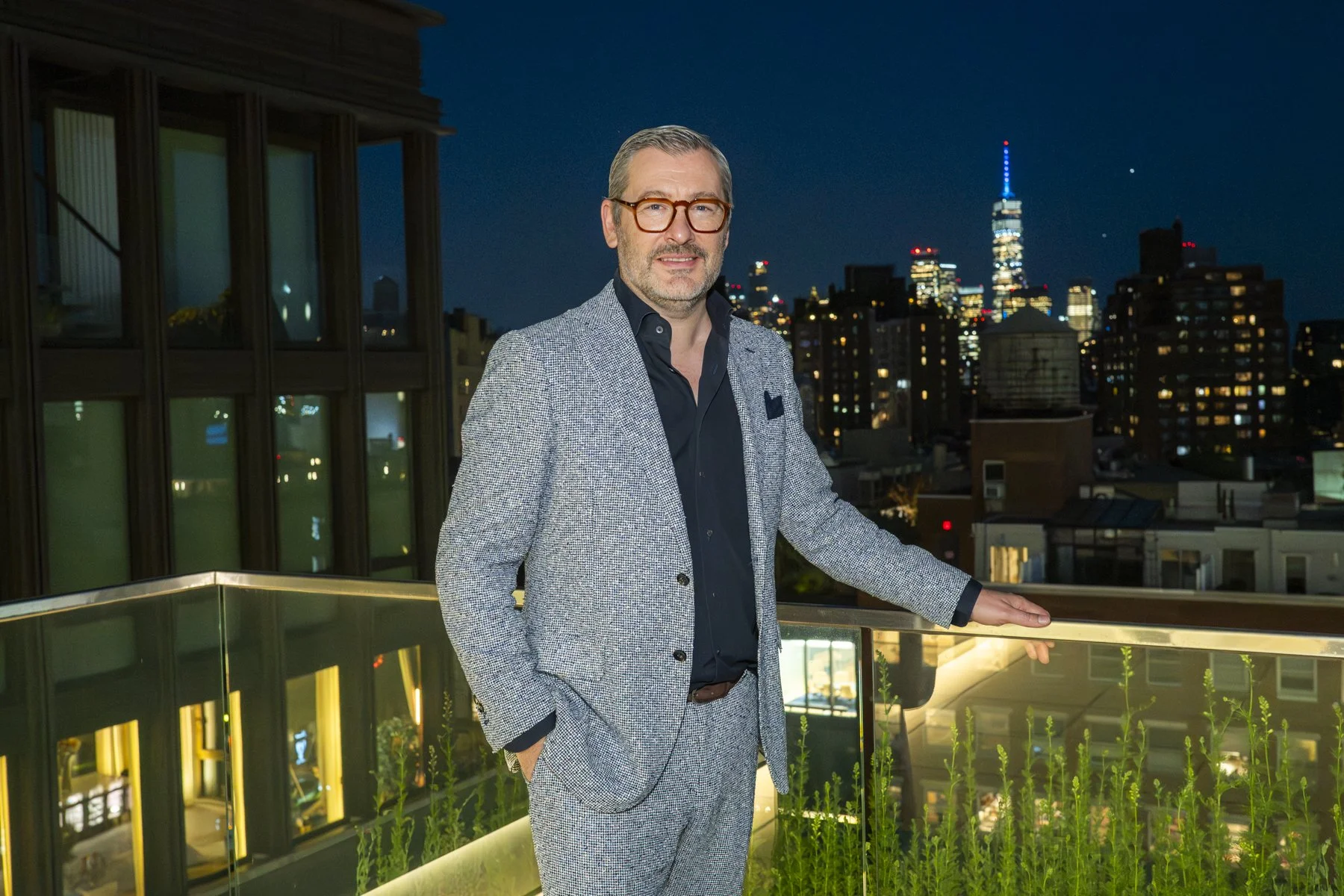
In the fall of 2024, Rolls-Royce named Domagoj Dukec Director of Design, a coveted role in the century year old car company defined by its exquisite collectible automobiles. The British brand Rolls-Royce falls under the purview of the BMW Group. In his previous role, Dukec was Head of Design for BMW. Whitewall spoke with Dukec at the Rolls-Royce Private Office in New York City during NYCXDesign about his 25-year career in automotive design that began at the Pforzheim School of Design and his vision for propelling Rolls-Royce into the future.
Were you artistic growing up?
When you have certain creative talents, you're more sensitive — your perception is heightened. You see everything a little brighter, you have a good visual memory, and you have a talent to express it through your hands. I was always drawing — not only cars. Comic books, animals, people. Any magazine with a face on the cover, I'd try to reproduce it. I found out that transportation design existed as a profession. I was thirteen.
Did you have a particular kind of car you were obsessed with?
I think every young boy likes what he sees on television — Magnum P.I., a Ferrari, cool guys driving sports cars, but I liked everything. The technical part combined with the aesthetic. At that time there were only two magazines on car design — a Japanese one and an Italian one called “Auto & Design” — both quite expensive. My father bought them for me every two months. Inside you got the whole story of the design process for every car.
Volkswagen Audi Group gave me a scholarship. In my sixth semester they asked if I wanted to do an internship at a newly opened design studio they had set up in Barcelona. I tried to impress anyone who came from that studio to our semester presentations. The head of interior design asked if I wanted to join. Everybody who later became a design director somewhere passed through the Volkswagen Audi school. It was the Bauhaus of car design. Even Peter Schreyer, who went on to lead Hyundai and Kia. I was there three years. Then Jean-Pierre Ploué, who had been at Volkswagen with me, left for Citroën and asked me if I wanted to come to Paris. I moved to Paris for what I thought would be two or three years. I stayed ten.
“Rolls-Royce has always been a canvas. John Lennon, the Beatles — they used a Rolls-Royce as a literal canvas.”
That sounds like a wonderful era.
Probably the most important era of my life for understanding myself as a designer. After the Volkswagen school, where every line has to be parallel and rational, I came to France and found something completely different. The combination of German rigor and French emotional expression turned out to be much stronger. I always had in the back of my mind, I want to go to BMW eventually. I'm what you might call an emotional rationalist, Croatian origin, born in Germany, ten years in Paris. A mixture of German rationalism and something very Latin — very emotional. BMW had always spoken to me because it had that character — German in its precision, but with something else. That quirky shark nose. Something disturbing in a good way. It stood out. I understood very early that I never wanted to design something that already existed.
(BMW design chief) Adrian van Hooydonk and I would meet at designer events, at shows. He asked me to come to BMW. I spent three years doing all the front-wheel drive BMW models. The CEO at the time responded strongly to the work. They offered me the role of head of exterior design, then eventually head of design. Since around 2013, I was responsible for everything you see on the road now. Every BMW launched until 2032 was shaped during that period. In design, to be successful, you have to understand that you're not the person with the best taste — you're the person with the greatest empathy and sensitivity to understand what the customer wants. Like a good cook — you want to have enough sensation to make others happy. I like people to react. I like making people smile. I was always willing to say exactly what I thought, which probably helped — and occasionally caused problems.
Can you talk about how Rolls-Royce's design philosophy connects to the broader world — to art, culture, other fields of design?
Part of our strategy is captured in those two words: inspiring greatness. With such a strong brand, we want to show what humanity is capable of — with dedication, with passion. Inspiring greatness is much bigger than just the product.It's about how we interact with our clients, how we present ourselves, what we say to the world. We have only around five thousand cars. We have to make sure that not just our clients are happy — we have to make sure that society sees Rolls-Royce as something genuinely great. Rolls-Royce has always been a canvas. John Lennon, the Beatles — they used a Rolls-Royce as a literal canvas. It was part of pop culture even then. Pharrell Williams, artists from every field — they drive Rolls-Royces not because it's just a car. It's a motorcar in a different sense. We design our cars to be capable of becoming personalized by the owner. It's an art object and a canvas simultaneously.
I imagine the challenge of long-range planning at Rolls-Royce is different from more mass market brands.
There's always a long-range product planning horizon — ten to twenty years — where you have to imagine how Rolls-Royce will look in 2040. We've done that. If Rolls-Royce is often a chauffeur-driven car, does it really make sense that the chauffeur sits in the front and the owner sits in the back, unable to see anything? The further you push the initial idea, the stronger the concept stays — because there will always be reduction as the process advances. If I ask a designer to be as realistic as possible from the start, there will be no movement at all. We may as well just finish the current year's car and go home.
How do you motivate your designers to engage with these extreme long-range concepts?
My role is more tactical now. If I let every designer just draw whatever they think is right — all of that may be valid, but it's a waste of energy. I'm part of the Rolls-Royce board, so I know the direction the brand is heading. My job is to frame the design strategy and say: focus on this fifty degrees of the 360. Anything you put inside that space is fine — I don't mind if the lines go up or down —focus there. Your job as a manager is to channel that creativity into the right context — to make sure that what they create fits exactly what this brand, in this moment, needs.
How does car design relate to other fields — industrial design, architecture?
Rolls-Royce sits at the intersection of all of them. It's an art object that inspires artists. It's a functional sculpture. It's a canvas for personalization. It connects to fashion, to architecture, to cultural expression. The design challenge is different from any other car company — but that doesn't make it easier. In some ways it's harder, because the expectation of perfection is absolute. Our founding principle —strive for perfection — doesn't mean perfection is always achievable. It means even if you manage to make something just one percent better, that's the story. Always trying, no matter the constraints, to make it a little bit better. The puzzle for Rolls-Royce is a different one — but it's still a puzzle, still challenging. It's not easier because fewer cars are being made. If anything, it's more challenging, because you're focused on the most profound level of meaning. You won't see superficial change — but inside, with every step, you have to create something meaningful. That's what I'm looking for. It's a completely different way of doing design.